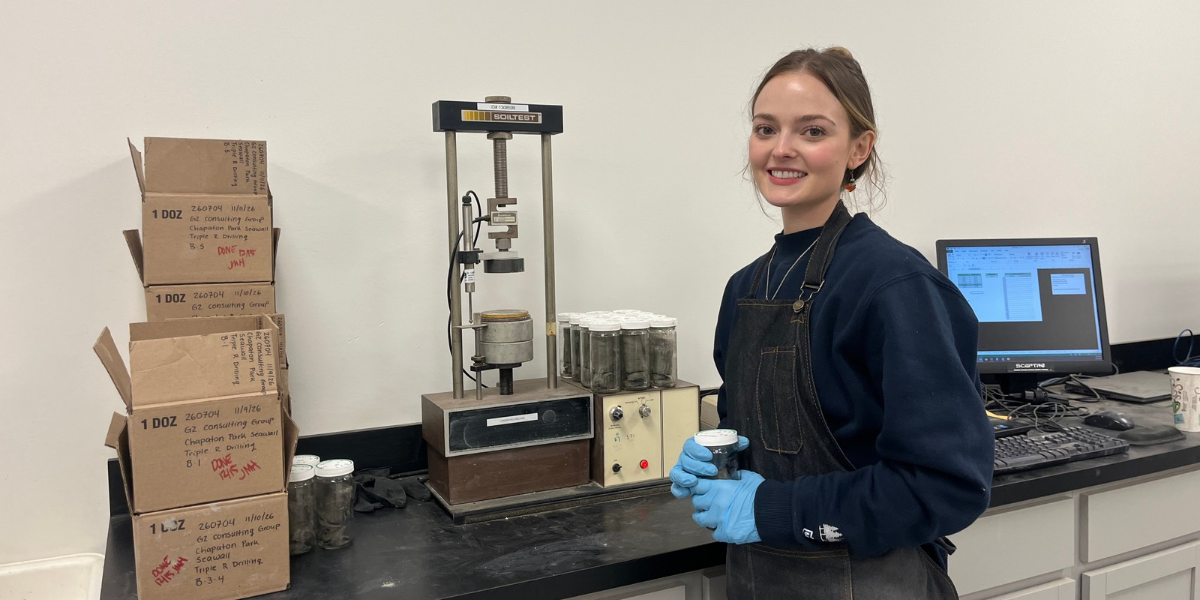
Ever wonder what goes on inside a geotechnical lab? From testing materials and preparing samples to sharing results with project teams, there’s always something happening behind the scenes. Join me for a week in the G2 Troy lab to see what life is like as a staff geologist and how our work helps keep projects on track.
Monday
I start the day by checking our cure room to make sure the concrete cylinders molded by our field staff are in place and ready for testing on their assigned dates. I then print an updated log-in sheet that tracks the cylinders scheduled to arrive the following day. This is part of my daily routine, both first thing in the morning and again before I leave.
Next, I begin a sieve analysis on a Class II Sand sample brought into the lab. A sieve analysis determines the particle-size distribution of aggregate by passing the material through a series of sieves and measuring the amount retained on each one. I split the air-dried sample to the proper size and allow it to dry completely before continuing the test.
I then run several unconfined compression tests on soil samples collected from split-spoon samplers from geotechnical borings to evaluate the soil’s undrained shear strength. Once testing is complete, I upload the results into our soil boring log program, dIRT, and let the project manager know they’re ready for review.
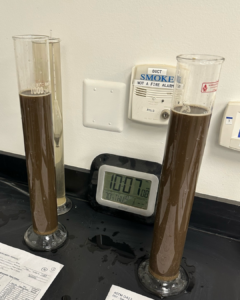
To wrap up the day, I prepare samples for hydrometer testing later in the week. This test helps determine the distribution of fine-grained particles in a soil sample. I sieve the samples and place a measured amount of material into a solution of sodium hexametaphosphate and distilled water to soak.
Before heading home, I check the cure room one last time. You’ll start to notice a pattern!
Tuesday
After checking the cure room, I begin the hydrometer tests prepared on Monday. These tests are time-sensitive, especially when multiple samples are running at once. Readings must be taken at specific intervals to measure how fine soil particles settle in suspension. This takes up most of my morning.
Next, I perform a modified Proctor test on samples received from our field staff. This test determines the soil’s maximum dry density and optimum moisture content, helping establish the moisture and compaction requirements needed to achieve proper performance in the field.
I also run the Atterberg Limits Test in accordance with ASTM D4318. This test identifies the liquid limit and plastic limit of fine-grained soil, helping classify the material and assess how its consistency changes with moisture content.
I complete sieve analyses on aggregate samples that have already been washed and dried. By separating the material through a series of sieves, I determine its particle-size distribution for classification and evaluation. I then take the final hydrometer reading 24 hours after the test began.
Before the end of the day, I upload completed test data into dIRT and share the results with project engineers and project managers. I finish by completing the day’s laboratory documentation and checking the cure room.
Wednesday
The day doesn’t begin until I check the cure room! Afterward, I record the dry weights of samples from the liquid and plastic limit portions of the Atterberg Limits Test. I then take the 24-hour hydrometer readings and wash the sample over the No. 200 sieve, the smallest sieve in the stack, to remove the finer particles before placing it in a container to dry overnight.
Around 10:30 a.m., I head to the Wayne State University Engineering Career Fair with our recruiter, Lauryn Hulett. As a Wayne State graduate, it’s great to return to my alma mater. I enjoy talking with engineering students about career opportunities and sharing my own experience. I spend the rest of the day at the career fair.
Thursday
I start the day by checking the cure room before completing the final sieve analysis for the hydrometer samples that were washed and dried earlier in the week.
Our intern, Bianca, shadows Dina, our lab manager, and me as we run an aggregate sieve analysis in accordance with ASTM C136. We begin by splitting the sample to the proper size based on the aggregate specifications. I also walk Bianca through the charts we use to help her understand the Michigan Department of Transportation (MDOT) specifications for different gradation requirements.
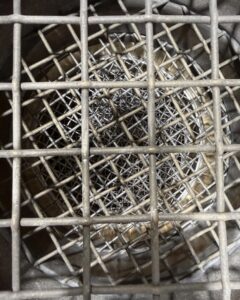
We dry the sample to a constant weight and allow it to cool, then wash it over the No. 200 sieve using a mechanical sieve washer to remove the finer particles. After washing, we dry and cool the sample again before running it through the sieve stack. The sample is shaken for 10 minutes before we record the weight of the material retained on each sieve. I document the results on paper for Dina, who uploads and reviews the data to confirm that the aggregate meets the applicable gradation requirements.
My day ends with helping identify rock cores brought in from Pennsylvania and, of course, checking the cure room.
Friday
My supervisor, Dina, is out of town, so I take on additional responsibilities throughout the day. After checking the cure room, I receive three crushed concrete samples for sieve analysis and rubble pick testing.
I process each sample by reducing it to the proper size, washing it over the No. 200 sieve to remove fines, and running it through a sieve stack to determine whether it meets MDOT 21AA requirements. I manually identify and separate rubble and other non-soil materials retained above a designated size and document the results.
With Dina away, I also help coordinate incoming samples and testing priorities by communicating directly with project managers and field coordinators regarding sample status, test results, and scheduling to ensure requested testing is completed and properly documented.
Throughout the day, I perform several unconfined compression tests on cohesive soil samples. I prepare specimens and test them in the unconfined compression machine to determine their strength.
As the week comes to an end, I focus on completing priority testing so time-sensitive results can be delivered to the project team. I organize samples and review upcoming work to ensure I understand next week’s priorities. Before heading out for the weekend, I check the cure room one final time.
Week Wrap-Up
Every day as a staff geologist looks different. With new materials coming into the lab and different tests to run, there’s always something new to work on. The range of work keeps me engaged and involved in the different projects we support at G2.