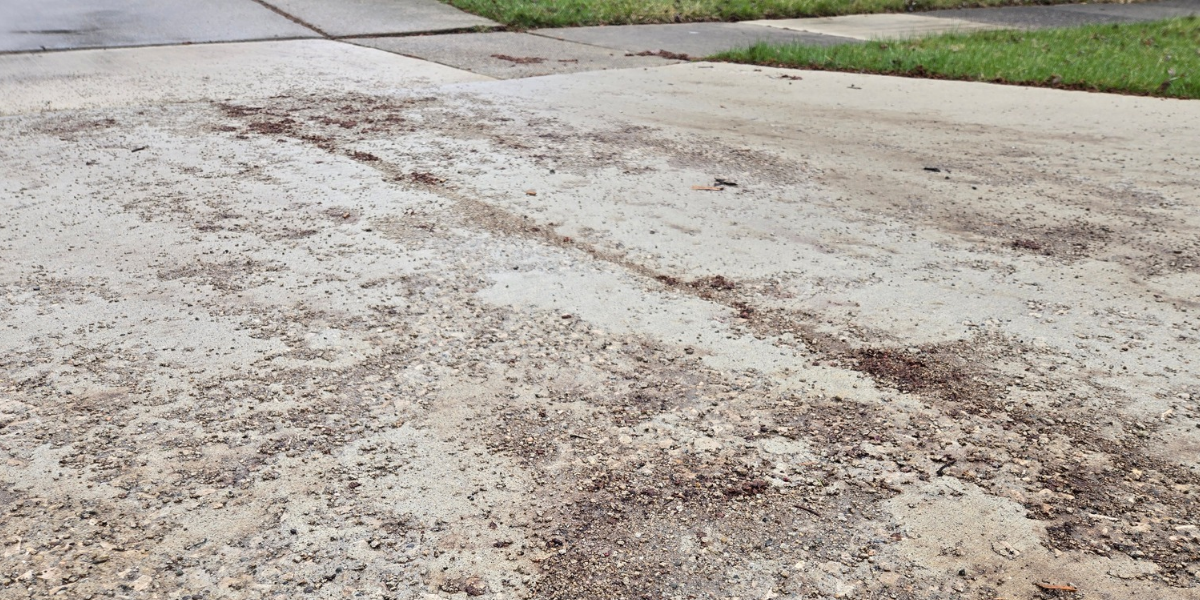
Concrete scaling has become an increasingly important issue throughout Southeast Michigan, making it essential for engineers, contractors, and project owners to understand why it occurs and how to reduce the risk.
G2 Project Manager Jim Berry, P.E., discusses the causes of concrete scaling and the best practices to improve long-term concrete performance.
What is Concrete Scaling?
Concrete scaling is the loss of a portion or the entire finished wearing surface of a flatwork slab. Although scaling typically does not impact the structural integrity of the concrete, it can significantly affect the appearance of the finished surface and may lead to costly repairs or replacement. For municipalities, commercial property owners, and developers, widespread scaling can become both an aesthetic concern and a maintenance issue.
What Causes Scaling?
Scaling occurs when two environmental conditions are present: water saturation and repeated freeze-thaw cycles.
When water penetrates the concrete surface, it reaches a thin mortar layer, typically 1 to 3 millimeters thick, that sits above the uppermost coarse aggregate particles. As temperatures drop below freezing, the trapped water within the coarse aggregate particles expands, creating pressure within this surface layer. If the mortar lacks sufficient strength, that pressure can cause it to separate from the underlying aggregate, resulting in the surface flaking or peeling.
Several factors can increase the likelihood of scaling, including improper finishing practices that increase the water-cement ratio at the surface, finishing concrete while bleed water is still present, an inadequate Entrained Air System, insufficient curing before freezing temperatures, and the premature use of de-icing salts. Avoiding these factors and following proper mix design, placement, and curing practices can help reduce the risk of scaling and improve the long-term durability of concrete flatwork.
Why Concrete Scaling is Becoming More Common:
While scaling has always occurred occasionally, the construction industry has seen a noticeable increase in widespread surface scaling over the past several years.
One significant industry change has been the transition to Portland limestone cement (PLC), which became widely adopted in North America beginning in 2022. PLC offers environmental benefits by reducing the carbon footprint associated with cement production. However, many industry professionals continue to study how these newer cement systems influence finishing characteristics and long-term surface durability.
Compared to traditional Portland cement, the limestone particles in PLC are ground more finely. That difference may be contributing to scaling in a couple of ways. Since the limestone particles are finer and lighter than cement particles, they remain suspended in the concrete longer while the cement settles more quickly. As a result, the very top layer of concrete may contain more limestone and less cement, creating a weaker surface that is more susceptible to scaling.
Another possible explanation involves bleed water. Since Portland limestone cement is more finely ground, bleed water tends to rise to the surface more slowly. If finishing begins before that moisture has fully evaporated, it can be worked back into the surface, increasing the water-cement ratio in the top layer and reducing its durability.
G2’s Approach
G2 works closely with owners, contractors, and ready-mix suppliers to evaluate concrete mix designs, review construction practices, and provide recommendations that help improve long-term pavement performance.
Concrete scaling remains an evolving industry challenge, and no single recommendation eliminates the risk. By staying informed on current research and applying proven best practices, project teams can make decisions that improve durability and reduce the likelihood of premature surface distress.