
At G2 Consulting Group, interns aren’t observers; they’re essential contributors to the work happening on job sites every day. Lily Kennedy, a civil engineering student entering her junior year at Wayne State University, exemplifies what it means to learn by doing.
Lily joined G2 because she wanted something different from a traditional office internship. She wanted to be outside, problem-solve in real time, and see firsthand how infrastructure is built from the ground up. “Being able to travel to job sites, talk with contractors, and actually test materials being placed, that’s what drew me in,” she says. “It’s the kind of experience you just can’t simulate in a classroom.”
Here’s an inside look at a full day in Lily’s internship, and everything she’s learning along the way.
6:00 AM – Early Start
I am getting ready for the day, packing my gear, and ensuring I have all the necessary equipment. I make sure I have my slump cone, air meter, nuclear gauge, cooler, PPE, and G2-issued iPad. I grab breakfast and run through my plan for the sites I am visiting. These early mornings are quiet, and they give me time to get mentally organized before the fieldwork begins.
6:30 AM – On the Road
I am heading out in my G2 company vehicle, which makes traveling between sites manageable and efficient. The first stop of the day is the Easterseals Center for Autism. I drink my coffee and think through the testing I will be performing once I arrive. Every day is different, and that is what makes this internship exciting.
7:00 AM – On Site & Getting Set Up
I pull into the site and touch base with the contractor to confirm timing for the concrete placement. This project involves installing sidewalks behind the building, and most of the structure is already complete. My testing will help confirm that the concrete being placed is workable, durable, and strong enough for long-term use.
I begin setting up my equipment, so I am ready once the truck arrives.
7:20 AM – Concrete Truck Arrives
The truck pulls in right on schedule. The pace on site instantly shifts. I double-check my equipment and take my place near the pour area. I like this moment in the morning because it signals the start of the technical work I came here to learn.
7:30 AM – Testing Time
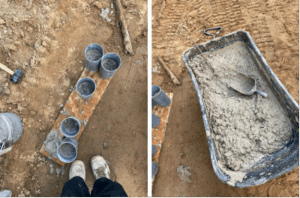
Once the pour starts, I start performing air content tests, slump tests, and preparing cylinder samples (pictured below). Each test tells us something important. Slump shows how workable the mix is. Air content verifies durability through Michigan winters. Cylinders will be strength tested in the lab later and will become part of the record for this project.
I share results with the crew as I go so they can make any necessary adjustments. Working alongside contractors in real time has helped me grow more confident in my ability to communicate field results clearly.
8:00 AM – Clean Up & Report Writing
I clean my tools and then sit down to complete my report while everything is fresh. Documenting details accurately is a huge part of engineering. I have learned how important it is to write reports that are clear, consistent, and complete.
8:30 AM – Cylinder Pick-Up
Before I leave the site, I collect concrete cylinders from a previous day’s pour. These samples will be tested for compressive strength later in the week. I place them carefully in the cooler, so they stay in good condition during transport.
Then it is time to head to my next project.
9:30 AM – New Site, New Test
I arrive at the Farmington Public Schools transportation building, where a new parking lot is being constructed. This project focuses on asphalt, so I will be performing density testing with the nuclear gauge. Each reading helps determine whether the asphalt has been compacted well enough to support buses and maintenance vehicles.
I set up my equipment and check in with the crew to see how much longer until testing can begin.
10:00 AM – Hurry Up & Wait
The asphalt is still too hot to test. I monitor temperatures and walk around the site to get a better sense of where placement is happening. Waiting is part of the job, but it gives me time to stay observant and ask questions. I watch how the crew moves, how the rollers work on the pavement, and how quickly the material changes as it cools.
10:30 AM – Bit Density Testing
The asphalt reaches the right temperature, so I begin testing. I take density readings at several points, recording each result in my tablet. When numbers fall within the correct range, it is satisfying because it confirms the pavement will perform well. Quality control like this might seem small, but it protects the lifespan of the entire parking lot.
I continue testing throughout the morning until the contractor finishes the placement in my area.

12:30 PM – Reports & Wrap-Up
Before I leave the site, I finish my field report. Staying on top of documentation while I am still on site helps me remember key details and keep everything organized.
1:20 PM – Back to the Office
I return to the G2 office to log and store the concrete cylinders I collected earlier. Each sample is labeled and placed in the curing area, so it is ready for strength testing over the next several days.
I also check my email, look at the schedule for the rest of the week, and make sure I am prepared for tomorrow’s projects.
1:45 PM – Catching Up & Planning Ahead
I organize my testing equipment, review project notes, and check in with other team members. It is helpful to see what projects other field staff are working on, and it keeps me feeling connected to the team.
3:00 PM – Done for the Day
I wrap up the last of my reports and head home. Even on long days, the time goes by quickly because I am constantly learning something new. I am not just reading about civil engineering anymore. I am watching it and contributing to projects that people will use.
Interested in an internship at G2? Go to g2consultinggroup.com/careers/interns-co-ops to learn more!